
The continent shivered and shook as the great rift tore at the African tectonic plate like a sheet of paper. The subsequent crack gave Earth’s molten core a path of release, at unimaginable pressures and evil temperatures. The lava, having been captive in its subterranean prison for millennia craved the freedom of the earth’s surface. But the strata between the tectonic plate and the atmosphere will not give up the access to the lava’s freedom so easy. Despite this, nothing would stand in the way of the magma’s escape and with the great impetus of its power, it bulged the strata up towards the sky. Like a branch being bent by an unstoppable force, the layers that made up the strata snapped, creating a small pathway to the surface. The lava now had a route out of its dark dungeon. But the small fissure in the strata was insufficient to accommodate the great volume of magma flow. And in mighty frustration, the lava pushed the strata even higher towards the stars, cracking the earth wider. Finally, the lava found relief as it poured out like champagne onto the slopes of this newly created mountain. The surface of the land had never before experienced the inexorable flow of lava and not even the massive rocky boulders could stand in its way. The magma tore down the mountain, devastating everything in its path. It pumped itself out until it was satisfied and the rage of its origin subsided.
In its liberty, the lava gifted the earth with new rock formations, rich minerals and a new mountain feature that would become Africa’s finest. In the aftermath of its eruption the lava left behind the first crater, Shira. However, in its hunger for freedom, this single crater and point of release was not enough and thus the lava repeated this cataclysmic process twice more, creating the craters of Mawenzi and Kibo. The third and final crater, Kibo, was the lava’s most spectacular creation. It forced the crater, almost religiously, higher up to the heavens; higher than any of its predecessors; higher than any of its future companions would ever reach. Finally, the lava ceased its relentless offensive on this point of the earth and moved on to its next target. The bulge in the earth with its triplet craters and peaks was left to recover and evolve.
For the very first time, the Kibo crater, now well above the snow line, experienced the soothing effect of snow on its scorched surface. A type of precipitation extremely rare for a feature so close to Earth’s primary horizontal dividing line! The snow fell each night, froze solid on the cool peaks of the crater and each morning the sun’s rays would attempt, unsuccessfully, to melt the frozen blocks of ice. And so, slowly, day by day, these blocks of ice grew into rare equatorial glaciers. The crater peak was transformed from its birth as a rocky geological structure to a brilliant, white, pearl-like dome that radiated into the distance. The solitary, three-pronged mountain stood out like a prominent beacon within the flat, and otherwise insignificant, surrounding landscape.
The first humans to behold this mountain looked at it with awe. The bright snow-capped peak was exotic to the locals, who had never encountered snow. The kilima, the mountain, became the most significant landmark for the local Peoples. Its njaro, shiny, peak stood embossed like a diamond on a mighty crown. The mountain was christened with the apt title of ‘Kilimanjaro’, “the shiny mountain”.
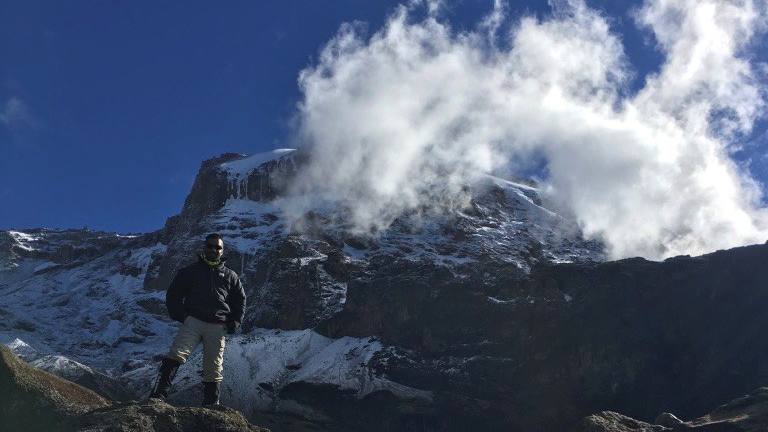
In the stifling darkness of that unholy hour, I peeked up towards the summit. The beam of my headlamp barely penetrated the thin air for more than five meters and I was no wiser as to the character of the beast that still lay ahead. All that could be seen was a line of headlamps winding up Kibo like a mystical snake. A snake with no head or tail! Slowly but continuously slithering its way higher! I took a sip of water and was struck by a ripple of panic as small chunks of ice flowed over my lips.
I trekked at the back of the column. In front of me were my seven other climbing partners and our lead guide, Gilbert. Four other assistant guides followed behind me, ready to offer any of us immediate assistance. We had been on the move since midnight and the pace was painstakingly slow. It was already 3AM and we had covered just 2 kilometers. The plan was to reach the summit of the mountain, Uhuru peak, at 6AM; in time for the sunrise. Summit attempts from the western routes all start at the Barafu camp, 4673 meters above sea level. Uhuru peak is a short but arduous 5 kilometer hike from Barafu and the recommended hiking time is seven hours. Therefore the standard practice is to depart from Barafu at 11PM with the intention of reaching Uhuru peak by 6AM the following morning. We had departed from camp one hour later than planned and we barely managed to march more than 600 meters per hour. At that rate the Uhuru sunrise was a forlorn concept. Gilbert was trekking at a pace comfortable for Karin, who had been plagued with altitude sickness ever since the Shira Cave camp. Karin’s journey thus far was in itself a small miracle but the true miracle was yet to follow…
I met Karin for the first time in Nairobi during a short layover before our flight to Kilimanjaro International Airport in Tanzania. We had known of our common existence and our conjoining Kilimanjaro expedition plans but had not been in contact in any way prior to that meeting. Over the next few hours Karin introduced me to the rest of the climbing party. These guys represented a church based NGO called Life Child and this expedition was planned with the intention to raise awareness and funds for their cause. I, on the on the other hand, had no Life Child affiliation whatsoever and was simply looking for a group to tag along with. The fact that I ended up with this weird and wonderful bunch was the first of many little miracles that this trip had in its armory. I was rapidly and seamlessly integrated into the group and by the time we started the first day of our hike, I felt like an honorary Life Child member.
Kilimanjaro dominates the Moshi skyline. Although the apex remains masked in a cloudy cloak for most of the day, only revealing itself in the early mornings and late evenings, its presence is an ever intimidating certainty. So, in spite of the clouds denying me even a glimpse of the summit on the first day, I was under no false apparition as to the challenge that lay ahead of me. In the months preceding the commencement of my expedition, I had planned and prepared meticulously. My planned climbing path was the Machame route, a scenic seven-day-six-night trek to the summit-and-back. My preparations included a number of practice climbs, one in excess of 3300 meters above sea level, and a strict fitness and diet routine. Then, there were also the arrangements for the specialized gear I would require; from a minus thirty degree Celsius sleeping bag to a thermal balaclava to weather resistant recording equipment. Standing, on that first morning,at the Machame gate, the entrance to the Kilimanjaro National Park, it dawned on me that all the planning and preparation was over and that which was well planned and prepared for would be easily overcome but those other unforeseen scenarios would have to be conquered by ingenuity and power of will.
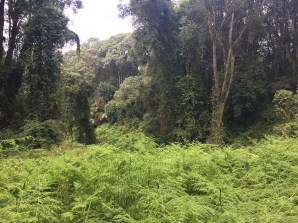
The Machame gate is at 1800 meters above sea level, about 1000 meters higher than the town-center of Moshi. We headed off from this point on a solid, wide and well-trodden dirt track on a warm dry day; that lulled us into a false sense of security. We would soon find out that the mountain pathways are typically single-track and that the weather was as temperamental as a new-born baby. Nonetheless, that first day’s hike, despite being long, was simple and stunning. The mountain is divided into five zones, the first being the cultivated zone, through which we had driven on our way to the Machame gate. The second zone is made up of a, somewhat misplaced, but beautiful rain forest; prime source of the first day’s splendor. I walked through this rain forest and could not help but stop and stare at the lush greenery around me. The largest trees create an overhead canopy, providing a greenhouse for all that exist beneath. The plant life is densely packed together with ferns so large that they often had me gazing upward at them. In addition to incubating all their subordinate neighbors, the forest canopy provided us a protective screening from the unrelenting equatorial sun. And so, it was in this cool and enchanted forest that we spent the majority of our first day.
We arrived at camp at around 17:00, exhausted but in high spirits. We found that our sleeping tents were already set up with our luggage and sleeping mats safely inside. In addition to that, for our group’s exclusive use, two temporary lavatories and a mess tent were also erected. The accepted system for climbing Kilimanjaro is thus. As a climber, you need only carry a light backpack filled with personal items that may be required during the daily treks. Everything else is, rather embarrassingly, carried by porters. These porters are sinewy super-mountain-men of such strength and endurance that they make Olympians seem like infants. Each morning, after we departed camp for the day’s trek, the porters proceeded to break and pack up camp. Thereafter, they would commence their trek to the next camp. Within an hour of us having left camp, we would find these porters nimbly lugging ungainly loads past us at astounding speeds. Then, almost miraculously, we would arrive at the next camp, completely set up, as if the whole thing had been moved by truck. By the end of the expedition my respect for our support team was absolute. This was the routine of life for the seven days of our climb. An arduous hike en route to the roof of Africa supported by a team of indefatigable and cheerful porters!
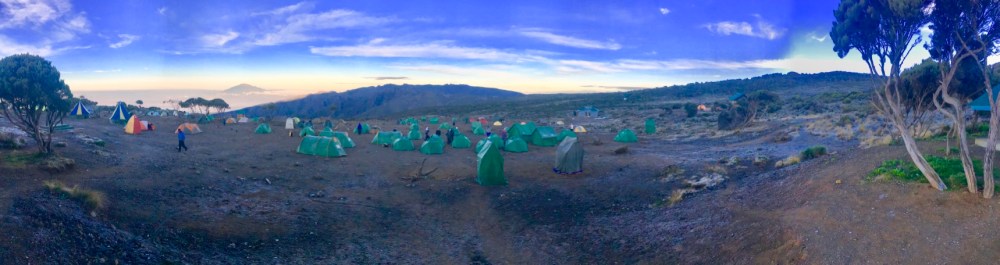
The daily treks, leading up to the Barafu camp, differed in character every day. Some treks were steep, with massive changes in elevation in either direction. It would often happen that a brutal uphill walk would be immediately followed by a welcome descent. The relief offered by the descent was always misleading and short-lived as knees and toes soon started taking strain due to the constant braking effect. Other treks covered the rough and dusty terrain of the alpine desert that resembled the surface of the moon more than any earthly ground, while others wound through the serene and mysterious moorland zone.
The mountain is an independent entity with multiple personalities. The weather on the Kilimanjaro massif altered almost hourly. One moment we would be tormented by the glaring rays of the sun, seeking the protective screening of our sunblock, and the very next the heavens would open and we would be scrambling for our rain gear. Sometimes the rain would turn to ice. Small enough not to present a head injury risk but large enough to send shivers down your spine, both in the literal and figurative sense!
Nights were the toughest. For while the mountain fluctuated its temperature during the day, the nights were constantly cold. Each night, the cold would envelop me until it permeated the very structure of my bones. Sleep was a fleeting concept. A forlorn activity; only for those in the comfort of a home! For me, it seemed as if the cold penetrated from the hard ground and the air alike and all my efforts to retain body heat were futile. From the third night onwards, my sleeping clothes were those that I had packed for the snow-capped summit. I would awake each morning to find my due-drenched tent frozen stiff. Along with the tent, I would await the first rays of the sun to thaw out the blood in my veins. However, the mornings were the only times when the mountain was consistent and gentle in nature. During the course of the night, the cold would banish the clouds back down to the valleys from whence they came. So during these times, not only was the weather calm, but the peak of Kilimanjaro was revealed in all its glory. Nonetheless, the heat of the tropical sun soon lifted the clouds back to the heights of Kibo and Kilimanjaro would resume its temperamental onslaught from behind the screen of mysterious clouds.
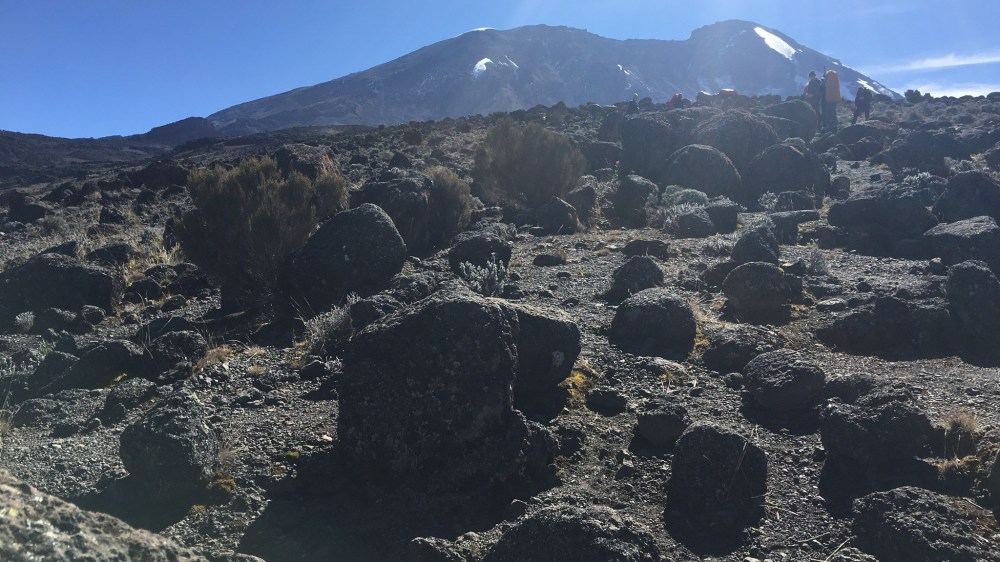
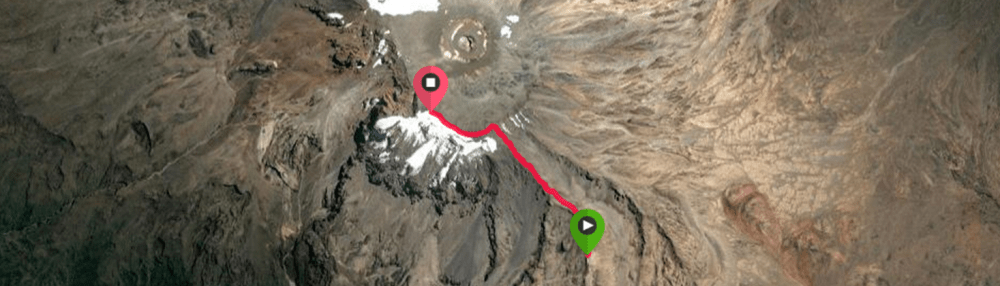
Like a Bedouin tribe, we migrated daily from camp to camp, inching our way towards the sky. We marched through the Moorland, from the Machame camp, up to the once towering but still impressive Shira crater. At Shira the caves offer a perfect shelter within the volcanic rock for a night’s rest. From Shira, we trekked through the spooky Alpine desert up to the lava tower and then back down to the Barancu camp on the fringe of the Moorland. From there we climbed up and over the Barancu wall, for which the camp is named. That was probably the most dangerous part of the climb, where a lost footing or loose load could have proved fatal or at least grievous. From the top of the wall we made our way down through a col and then back up to the Karanga camp. Then finally we hiked up to the Barafu camp, from where we would make our summit attempt.
The mood at each camp changed daily and was a separate being on its own. While we were eight independent individuals, our mood as a group was singular. The mood at Barafu was somber! By then, the true scale of what we were tackling was a harsh reality. Apprehension mixed with anxiety and a generous portion of fear, all simmering for days, had together produced this stir of emotion. Apprehension of stepping into the unpredictable! Anxiety to our body’s and mind’s capabilities! And fear of life and death!
For some macabre reason, a discussion on recent Kilimanjaro fatalities ensued upon our arrival at Barafu. I, in particular, had just been warned to stay on the path during the summit attempt. The reason for this was two-fold. It had been my tendency on the five day’s leading up to Barafu to drift off the beaten track. Although I didn’t stray further than twenty or thirty meters from the group, I found these little detours to be a much-needed sabbatical from the mundane single-file march. It gave me a chance to reflect and absorb the encircling beauty. This was the reason for my being singled out in this strict warning. The second reason was more general in its intended audience. The hike up Kibo is steep and icy and would be done in the dark, thus the risk of fatal falls would be increased by little off-road excursions. This caution naturally led to a disturbing conversation on the history behind it. Some unfortunate climbers had, in the past, ventured too far off the path, not realizing that they were on the edge of a precipice, and ended up plummeting to their deaths. Other climbers, plagued by mountain sickness, had been infected by madness and run off wildly into the black of the night, never to be seen again. This gloomy and inappropriate conversation only served to trouble our worried minds further.
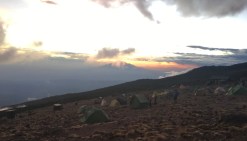
We arrived at the Barafu camp late in the morning of the fifth day. This was the day that months of preparation, planning and dreaming had led to. The day where challenges were to be defeated for the ultimate crescendo of success! We settled into our tents and thereafter met up for lunch and a briefing. The plan for the day was a short acclimatization hike at midafternoon, followed by an early dinner, whereafter we would rest until 10:30pm and then depart for the summit half an hour later. This well-thought-out plan would allow us to get to the summit just before sunrise and experience the mountain and the majestical views it offered.
Lunch, the acclimatization hike and dinner all passed dreadfully slowly albeit in much of a blur. Dinner was followed by a final briefing and an inspirational message from Gilbert, stressing to each of us once more that this final push would be a battle of the mind more than a battle of the flesh. The evening was cold. Colder than it had been on any of the preceding days! This fed fuel to my fear. Was I truly prepared for a wintery mountain assault? Would my body, much accustomed to the warm African sun, cope with an enveloping icy atmosphere? Nonetheless, I proceeded to meticulously prepare. I started by packing all the gear I would need into my daypack. I stuffed my water bottles into a used pair of socks to insulate them from the ice. I packed my camera into a plastic bag with a drying agent to prevent its mechanisms from freezing and jamming. I dressed myself, layering over sufficient protection so that in the end I donned no less than seventeen items of clothing. My plan was to sleep till my departure time, in full regalia, except for my hiking boots and gators.
All my physical preparation was complete by seven-thirty and all that was left to do was prepare my mind. Shantal, during a phone call the night before the start of the climb, proposed that there must be a deep purpose for me doing this climb. Shantal, in spite of being half a continent away, was with me the entire time. My fears were her fears, my setbacks were her setbacks and my victories were hers too. I chatted to her whenever there was sufficient service to allow a phone call. These calls always fed me and lightened my mood immensely. Even the rest of my climbing party recognized the glow that each chat with her brought to my being. It is a prime source of inspiration to know that someone special back home loves you enough to put her mind in yours and live this journey with you as if it were her own. We had talked about this ‘purpose’ on most of our subsequent conversations during my climb and each time this idea of a ‘greater purpose’ incubated inside me. I had initially set out on this expedition with the idea of obtaining the ultimate bragging right. Who would not take pride in a statement like “I’ve just climbed Kilimanjaro, the roof of Africa”? However, this notion of a ‘bigger purpose’ intrigued me. Yes, there were the experiences of the wonder of nature and getting away from the constructed world. And yes, there was the gauntlet through which I would push my body to its limits. But this still did not answer the question of a bigger more profound purpose. A question to which I would soon find the answer, in a supernatural manner! With that in mind, I started my final and most important preparation. That of my mind and soul!
Now for those readers that have more secular belief systems or just simply another belief system altogether; please read the subsequent portion of this blog with an open mind. I am in no way trying to change your beliefs, I am simply relating my experience to you. If this does have some sort of impact on you, that’s great. If not? Then that’s fine too.
My mental preparation was supposed to be simple. A prayer, like the prayers I had prayed just before bed on each of the previous nights up there! This time though my prayer turned to an appeal for strength. The fear of failure and ill-health had overwhelmed me and I knew for the first time since the start of the trip, with certainty and trepidation that my success and wellbeing was not in my own hands. So I prayed, not only for strength and endurance, but for wisdom to find a deeper meaning in this endeavor. And finally, I handed over to God my body, mind and spirit. Something I had never been able to do before! I love control and the relinquishing of thereof is always met with resistance from my mind. But this time I did it contently. And suddenly my eyes were filled with tears as a sense of peace and absolute wellbeing came over me. I knew then that in me relinquishing control, I had also relinquished accountability and that no matter the outcome of the next few hours, God would define the tale of my success. And that success would far eclipse my own vision thereof. Thereafter, I rested with a light and trouble-free spirit. And when the rain and snow fell over our camp, a mere two hours before our departure time, I had no lingering sense of dread for I knew that my destiny lay not in what this mountain would unleash or in my own ability, but it lay secure with a much higher power. Philippians 4:13 – I can do all things through Christ who strengthens me. I printed this verse on my backpack before I finally fell asleep and decided that this verse was the most important item I would carry up with me.
I woke up at half past ten that night and within ten minutes I was ready to leave. My back pack was full, my body was shielded and my mind was equipped. I walked out of my tent to find that the snow was still falling lightly but that the night was not as cold as I had expected. I joined a few of my other early-riser climbing mates in the mess tent for a light energy-builder departing meal. I ate, in spite of not being too hungry. A bizarre change from my recently voracious appetite! Eventually we were all ready and seated in the mess tent. Nerves, coupled with the heady effect of the light air had led to a few members taking slightly longer to prepare.
Gilbert had started testing our oxygen saturation levels and blood pressures ever since the Shira camp. This, he did with an oximeter that simply clipped over our fingers and after a few seconds spewed out a reading. My data was consistently excellent! Oxygen saturation levels above 95% and blood pressures on the normal to low side! This was evident in the complete absence of headaches, tummy troubles and loss of appetite in my body. The only other climbers to get to these consistently high levels were those on Acetazolamide, commonly known as Diamox. Diamox is a drug used to treat altitude sickness, amongst other diseases. My drug was growing up in a polluted part of the Highveld, where the altitude ranges between 1500 and 1700 meters above sea level and the air quality is generally poor. On this night though, my oxygen saturation levels had dropped to 90%, lower than it had been all week but higher than is normal for that altitude. I had learned previously that long, deep breaths were key in maintaining a high oxygen saturation level. So this lower level did not perturb me too much. Karin, on the other hand, had combatted low oxygen saturation levels since the Shira camp. Her oxygen levels had dropped so low that Gilbert decided not to take her up on the acclimatization hike earlier in the day. The mere fact that she had made it this far was a victory on its own. For this final stretch though her oxygen levels were low but acceptable for her to make the attempt.
Oxygen levels are critical to any successful mountain climb and understanding this concept is important in relating my experience. So please bear with me in this little science lesson. Air pressure is directly proportional to altitude. Much like a deep-sea diver who experiences higher pressures the deeper he dives, we experience higher atmospheric pressures at lower altitudes. Picture the air above you as a layer of water, the surface being at the edge of space. The deeper we dive down from this artificial surface into the depths of the atmosphere, the higher the pressure. The average level of the oceans can be considered as the floor of our air-filled tank. For most of us, this is as far away from the upper surface of the atmosphere that we can get. There are of course places on earth that get deeper. Some mine shafts go deeper than a thousand meters below sea level and the shore line of the Dead Sea is more than four hundred meters below sea level. But, for most of us this absolute atmospheric depth is mean-sea-level. ‘Mean’, not because the seas are angry, but because they are fluctuating and ‘sea level’ refers to a commonly accepted, albeit much debated, average! The air pressure at sea level is approximately one hundred kilo pascals (kPa). As you climb away from sea level and up towards the surface the atmosphere, the air pressure will reduce proportionally. So the pressure in high altitude cities like Johannesburg or Detroit is about 84kPa. The pressure up on the peak of Kilimanjaro is approximately 50kPa and as low as 33kPa on the peak of Mount Everest.
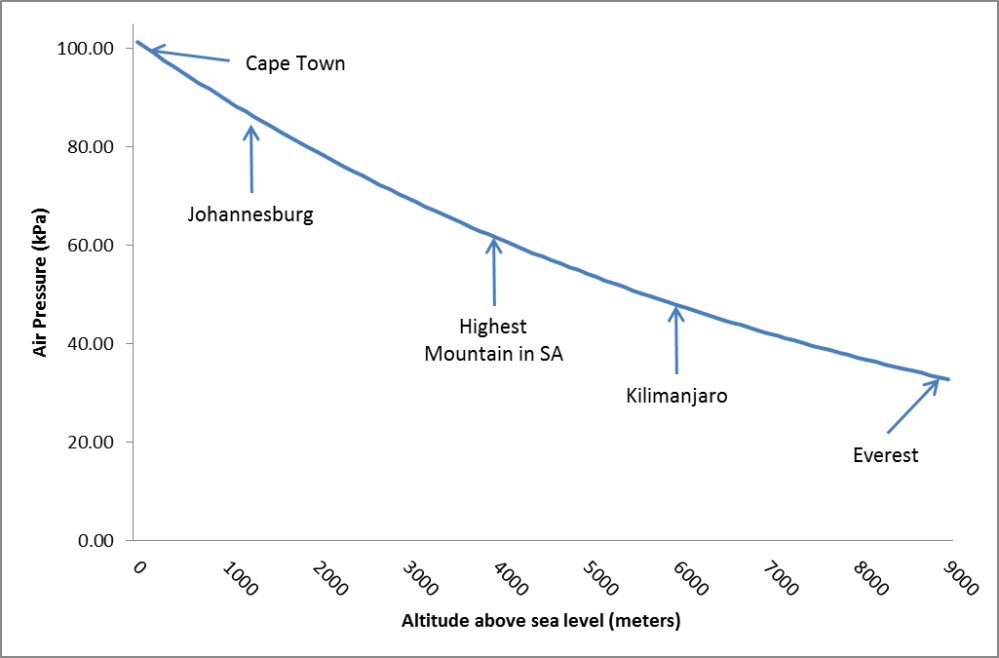
Now I’ve rambled on a lot about air pressure, but what does this have to do with oxygen. Well, oxygen levels in dry air fall proportionally with air pressure. Why? Basically the low pressure causes everything to be thinner or less dense. So, the elevation on top of Kilimanjaro causes the atmospheric pressure to be very low and this in turn causes the oxygen level to be less than fifty percent of what it is at sea level. So What? It’s simple! Our bodies need oxygen to survive and starving our lungs of this precious gas, in essence, means that we are slowing asphyxiating. And that’s what happens at extreme altitude! The human body will start to slowly ‘choke’ to death. Now I cannot comment on the medical science behind this, but altitude sickness can lead to high altitude pulmonary edema or high altitude cerebral edema, both of which can be fatal.
The effect of high altitude may seem like a phenomenon that only affects mountaineers but we all experience the effect it, often unnoticed. Air planes pressurize their cabins when cruising at high altitude but not to the equivalent sea level pressure but to one equivalent to an altitude of two thousand meters above sea level. This could be a reason why people struggle to sleep on a flight! That air popping sensation that you feel when driving over a mountain pass, that causes babies to cry ceaselessly, is also caused by altitude changes. In the case of sports persons, performance levels are always superior when competing at sea level. Athletes use high altitude training facilities to improve fitness and endurance levels. Even vehicles perform better at sea level than at altitude. There are some advantages of high altitude though. The thinner atmosphere means that there is less drag or wind resistance. Flyhalfs can kick longer penalties, batsmen can hit bigger sixes and sprinters can potentially run faster.
For us though, the dwindling oxygen level meant that our bodies would be starved of a life-giving source with each step up.
At some point, while we were in the mess tent, the snow stopped and the heavens swept the clouds away. It happened as mysteriously as the effect it created. The night was serene and clear. The ground was compact, made firm by the snow. The air was void of the slightest ruffle of wind. Conditions, perfect for a heavenly spectacle! After Gilbert had declared us fit for the fight, we gathered in a circle and Babu Simba, Grandfather Lion, the pastor of the group, said a departing prayer. I do not recall the exact words of that prayer but I believe that God was right there in the middle of that circle. As real as a sports coach may have been during an inspirational team talk in the dying minutes of a final match. And then, we were on our way, all in silence as we faced off against our internal demons.
We only departed at midnight, leaving us with 6 hours to reach the summit if we wanted to arrive before the sun made its entrance. Gilbert trekked in the front of our single file column, followed by Karin and then the rest of our group. Four other assistant guides took up the rear guard. The true value of multiple guides lay in the upper reaches of the mountain. Barafu camp is at 4763 meters and Uhuru peak is at 5895 meters above sea level. Thus the barrier that lay between us and our goal was a, seemingly simply but gargantuan, 5 kilometer trek with a 1122 meter ascent. The math was elementary. We needed to walk at a pace of about 830 meters per hour and at the same time ascend by about 240 meters. Initially, it seemed to me that we would actually make it. While we didn’t exactly walk 830 meters in that first hour, we were only 80 meters short. I did not realize then, that 80 meters at that altitude may well have been 800 meters. It was somewhere during the second hour that it became apparent to me that our chances of summiting before sunrise were diminishing fast. Our pace had dropped to just over 600 meters per hour and we were stopping for breaks every ten minutes. Fellow hikers from other groups started to overtake us and then pull away from us, until we were almost at the bottom of the queue.
I had previously read that the peak is clearest in the mornings and that the sight of the sunrise from the summit is one to behold. In planning this trip, I had a definitive intent to make the summit in time to see this solar spectacle. I had even avoided all pictures of the sight in order to make my experience at the peak fresh and unspoiled. By the time we had departed from Barafu camp, this plan to make the summit before sunrise became something of a mini obsession. I constantly checked my GPS, calculating our progress and then recalculating the new adjusted plan forward. Eventually, at around 3AM, after covering a paltry two kilometers, I calculated that the pace required for the rest of the evening would be a nearly impossible 1000 meters per hour.
In the stifling darkness of that unholy hour, I peeked up towards the summit. The beam of my headlamp barely penetrated the thin air for more than five meters and I was no wiser as to the character of the beast that still lay ahead. All that could be seen was a line of headlamps winding up Kibo like a mystical snake. A snake with no head or tail! Slowly but continuously slithering its way higher! I took a sip of water and was struck by a ripple of panic as small chunks of ice flowed over my lips.
The night was arctic! Although calm and clear! The town of Moshi was visible as the southern sky was void of any clouds. Still though, the perfection in these conditions did not occur to me until much later. All that I could think of now was that I was going to miss the sunrise. That the cold would paralyze me! That my body would succumb to the lack of oxygen. The eerie appearance of the night and the dimly lit snow struck me with a sense of dread. Then I remembered the verse on my back pack and the contents of my earlier prayer. I handed everything over and now I needed to trust that all was in God’s hands. And quickly I regained that sense of peace that I had earlier on. And then, Gilbert stopped the group and released Ngosha, an assistant guide, and I to attempt the impossible task of summiting before sunrise.
A day earlier, after suspecting that the group that I was hiking with may not be able to make the summit in time for the sunrise, I had a small caucus with Gilbert. I requested that I be allowed, along with an assistant guide, to make a solo summit attempt. This proposal was not entirely accepted. Instead, Gilbert counter-proposed that I start the trek with the group and that he would release me if he felt that we would not make it in time. I trekked in those first few hours of that night with this plan in mind. When will he release me? Should I remind him? If he lets me go now, would I still have enough time to make my target? So when he finally told me to continue up on my own, I had a clear picture in my mind of what I had to do. Three thousand meters in three hours! And as with any such challenge, I accepted it with my excuse of failure ready and at hand. Gilbert left it way too late! I should have been allowed to go on my own from the beginning!
Nonetheless, Ngosha and I bolted off. I had not noticed how steep the slope that I was climbing actually was. My previously slow pace had masked that part of the strife. Now, at this new pace, there was a noticeable increase in elevation with each step. But; instead of buckling under this new effort, my body was filled with energy and ability that was not from this world. A sense of light-footedness overcame me and I knew with certainty that this was not my own strength. My strides became long, quick and confident. My breathing was a deep, rhythmical process that thoroughly nourished my blood. I did not feel short of breath once. I could feel and taste the cool crispness of the air each time I inhaled. My mind was void of all external disturbances, but was porous enough to take in and experience the full majesty of this lofty landscape. I continued to walk tirelessly, growing stronger, not weaker, in the thinning air. Quickly I started to haul in and overtake all the hikers who had passed me earlier. Then I started catching the hikers who had left camp earlier than I did. The line of headlights started growing shorter in front of me and longer behind me, until the road ahead of me was clear and I became the head of that snake. In passing other hikers, I was confronted with varying reactions. Some people, were warm and friendly and wished me well. Others were irritated at having to move off the firm path. A few gave me evil looks with eyes full of curses. One particular couple dished out a verbal lashing on me in some foreign language, which I dismissed with a nonchalant and somewhat friendly wave. Everyone I passed was breathing laboriously. Some were visibly struggling and stood still while fighting the internals of their minds. One lady sat on a rock and wept out loud. All the while, I pushed on at an unreal pace. Ngosha, forced me to stop for a rest at least twice. I am not sure whether this was for his, or my benefit! Stella point is the first major landmark on route to the summit, and when I saw the rock that marked its location, I knew with certainty that on this morning I would witness the sun rise from the roof of the continent. We had done the impossible! Trekked at almost 1150 meters per hour for two hours straight, at sky-caressing heights!
I rounded this Stella rock where I encountered a guide from another group, but who was from the same tour operator as Ngosha. Ngosha negotiated with him for a cup of tea to which he gladly obliged. This was a trivial experience but I mention it for a reason. That cup of tea was unmatched by any that I had ever drunk or may ever drink again. It was like it poured itself directly into my veins and then flowed to the tips of my fingers and my toes. Thereafter I had just 700 meters to walk and less than 170 meters to climb up to Uhuru peak with more than an hour in which to complete it. The final walk was a sensational experience which I can, at best, try to describe vaguely.
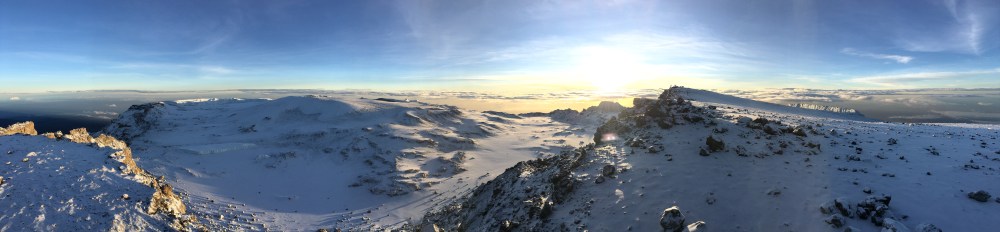
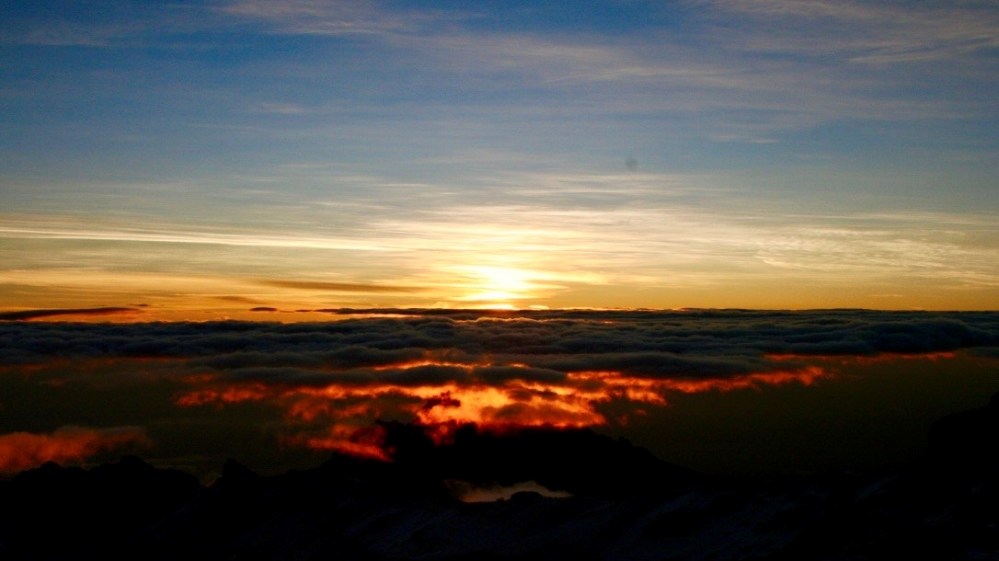
The eastern horizon took on that bluish hue with that bright burnt-orange lining that is synonymous with the African predawn. The east was full of clouds but up here, I stared down at these clouds. I was disappointed though because I thought it meant that the clouds would mask the full view of the sunrise. How wrong I was to assume that nature’s beauty could be diminished by an element of its creation. I would be corrected in the following hour. I walked in silent reflection as the light started to improve sufficiently to slowly reveal the splendor of my surroundings. A mountain glacier came into view on my far left. In that early morning, predawn light, it appeared blue in color, like the underside of an iceberg. It’s beauty was unsurpassed, but by the evolution of its fluorescent appearance as the light upon its surface brightened. Tears welled up in my eyes as I was humbled by the magnificence of that place. I felt tiny and insignificant! Yet like a king! And then, I was on the upper base of the Uhuru peak, with the signpost marking the pinnacle of the peak within view.
That rite of passage was not earned, it was a gift. I marched in slow motion and my mind and spirit absorbed the very soul of the precipice. The purity of the snow was almost symbolic of the spiritual nature of that place. Not more than ten climbers made it up in time to enjoy that morning’s sunrise, so there was an atmosphere of peace at the peak. Tears streamed down my cheek and my throat was filled with a coil of intense emotion. I reached a point adjacent to the summit signpost, got down on my knees and said a quiet prayer of thanks. Gary, my Californian climbing mate, had mentioned earlier that a mountain of this scale is where heaven meets earth. I had not read too much into that statement at that time, but now it dawned on me, as real as the sun dawned upon that peak, that it was so. I stood up and stared towards the east and saw a sight so magnificent that my mind could not comprehend it. The sun had finally broken past the edge of the horizon. But, it was still masked by the clouds that lay like a blanket between the summit of Uhuru and the surface of the earth. However, the sun would not be blocked out. Instead, it shone up through the clouds, turning them into a burning fireball. For a moment it seemed as if all the clouds had been set alight. It was the highlight of the entire trip. As if all the months of preparation and the climb itself had culminated in that very moment! Ngosha asked; “what do you think?” I simply shook my head and choked up, not able to utter a single word.
As if a blessing of strength and endurance to get to the summit was not enough, I was then graced with resistance. The standard procedure for climbers reaching the summit is to spend about ten minutes to take a few customary pictures at the Uhuru peak signpost and then start the descent. The conditions at those lofty heights are not conducive to life. The thin air and bitter cold deters most from even attempting to explore the precinct of the peak. However I decided, along with Ngosha, to get the complete Uhuru peak experience. The summit of Kilimanjaro lies on a small plateau, on which the Uhuru peak resides. I took a cool walk around this plateau and was richly rewarded for the effort. From the western edge of the plateau I could see the shadow that Kibo cast onto Mawenzi. Mawenzi lives both literally and figuratively in the shadow of Kibo! I saw the top of the Lava tower, dwarfed from this height yet so huge two days earlier. I touched the glacier on the south of the plateau as it wept in the early morning rays of the sun. It’s gem-like luminescent appearance was surreal, as if it were deposited there form a distant planet. The sun, when it had risen above the horizon of the clouds, revealed the eastern Shira crater in a bewitching silhouette.


I spent two hours in that towering paradise of the fifth and final zone called the ‘snow-scape’; mesmerized by every sight. For those two hours nothing mattered as all external influences were temporarily frozen. My mindset would be forever altered. I now know what it means to let go and trust, not just in God but in the people whom He has sent to help me. I learned to appreciate the many blessings in my life, especially those that are beyond the reach of money. I learned that God’s gifts often disguise themselves as curses to the human eye. Like the snow; that I initially viewed as a hinderance but turned out to be a blessing that compacted the path and made marching that much easier! Or the cold that created the perfect visual effects! I learned that I am not an island, that the support of friends and loved ones is a key ingredient to success. I found that people close to me went through my challenges with me even though they were half a world away. I have a deep appreciation for the beauty of life. There is something about pushing your body and mind to extremes and overcoming. Not only is it deeply satisfying but it builds character. It changes perspective!
I waited for my climbing mates till 8AM, after which I decided to start my trek back to camp. I was not sure if they had turned back or whether they were still on the way up. I met the rest of the group, minus Karin, on my way down, just before Stella point. Most of them looked strong albeit a little roughed up. The assistant guides inspired and took loads wherever they could. Earning the admiration and appreciation of every climber! With yet another gift of supernatural energy, I decided to walk back up for a second summit, to enjoy that moment with them.
I was told that Karin had told the group to go on ahead because she didn’t want to slow them down. I, and most of the rest of the group, assumed that she had turned back at some point. There was no way she would make it up in the condition she was in. After milling around the summit with my new-found family and taking more of the customary social media pictures, we headed back down. And again, just before we reached Stella point we came across another one of our group. Karin, accompanied by Gilbert, had dragged herself up there. It was impossible! I saw buzzards circling over her a few hours earlier. Her getting there was nothing short of a miracle. This just added the seal on this already marvelous trip. God was with every one of us, each in different ways. So the purpose of this climb was not to summit. That was secondary! The primary purposes were those that altered our lives. Those that made us better people! People that our countries and the world would be better off with! It made us conquerors. But not of our own power, but of the power given to us in grace by our Father above.
“How to get the best of it all? One must conquer, achieve, get to the top; one must know the end to be convinced that one can win the end – to know there’s no dream that mustn’t be dared… Is this the summit, crowning the day? How cool and quiet! We’re not exultant; but delighted, joyful; soberly astonished… Have we vanquished an enemy? None but ourselves. Have we gained success? That word means nothing here. Have we won a kingdom? No… and yes. We have achieved an ultimate satisfaction… fulfilled a destiny… To struggle and to understand – never this last without the other; such is the law…”
George Mallory, Climbing Everest. Last seen 250 vertical meters below the summit of Everest, 29 years before Edmund Hillary’s successful summit. Whether George actually summited or not, remains a mystery!


Prologue
As we progress as a species, fewer and fewer parts of this earth remain undiscovered. This is not our flaw! However, if in spreading our markers we leave nothing unspoiled, then our flaw is self-destruction. Two aspects of Kilimanjaro irked me and I believe we have a responsibility to repair these for humanity itself. The first is the disappearing glaciers. While on the summit, I saw a data gathering probe sticking out of the top of one of the glaciers. I was later told that the probe was initially inserted inside the glacier and was invisible. Every year the glacier shrinks, revealing more of the probe. There is no doubt that the earth is warming up. And while there is doubt in whether human activity is the primary cause of this, the fact that it is warming up means that this planet is being altered for the worse. I fear that my children will not experience these equatorial glaciers as I have.
The second is the mountain rubbish. Kilimanjaro is littered with human waste at every camp and along every established climbing trail. It is disturbing and gross. We as climbers can blame the industrial revolution for the shrinking glaciers, but we have only ourselves to blame for polluting the mountain. Cleaning up the mountain will be a simple task, keeping it clean will require education and a change in attitude. The earth is ours and so is Kilimanjaro; we have a duty to keep it clean that is even bigger than our duty to keep our homes clean.
I would like to make the following acknowledgements:
- My family and girlfriend back home whose prayers and support during my climb were food for my soul.
- Zara tours for their excellent service and for providing me a magical experience on Kilimanjaro
- The porters, guides, cooks and other support staff who took us to the summit and back. I have nothing but admiration for them.
- I would like to thank Gilbert and Ngosha in particular. Gilbert, for being an outstanding lead guide and leader. I could see the respect that even his staff had for him. And Ngosha, for taking me up and sharing that experience with me.
- My climbing mates:
- Anthony: For your light and entertaining mood and for being the spiritual leader of the group.
- Francesco: For bringing a smile to every moment and for recording and documenting the trip so comprehensively.
- Gary: For your generosity and your idea of “This is where heaven meets earth!”
- Karin: For proving to me that miracles are possible and for allowing me to join your group on this journey.
- Janina: For being one of the most remarkable people I have ever met. Your approach to life is an inspiration. I thought I was adventurous, but you are next level.
- Nelia: For our long conversations during the treks, even when we actually needed to spare oxygen for our lungs.
- Paul: For just being so real and without pretense. Your uninhibited demeanor during the climb was refreshing and entertaining.
 Rootsquire by Shaldon Naicker